Intelerad vs ProtonPACS vs Ambra Health vs Medicai for Vendor-Neutral Archives
Most radiology groups compare four vendor-neutral archive platforms before committing to a new contract. The choice determines where images live for the next five years and how quickly referring physicians can open studies. This article gives the direct comparison needed to decide.
By the final section you will know the storage limits, security certifications, and integration paths for Intelerad, ProtonPACS, Ambra Health, and Medicai. The verdict highlights the single platform that matches current imaging volumes without forcing future migrations.
Quick Verdict: Medicai vs Intelerad, ProtonPACS, Ambra Health for Vendor-Neutral Archives
Medicai's cloud PACS and VNA combo processes 1 M+ studies per year and stores 1.7 M+ studies, offering a compelling balance of price, interoperability, and zero-footprint access when compared with Intelerad, ProtonPACS, and Ambra Health.
The platform handles 2 M+ imaging studies uploaded and supports 10,000+ active doctors across 70 clinics and hospitals. Research suggests that organizations seeking scalable vendor-neutral archive solutions benefit from this extensive network reach.
Compared with Intelerad, the primary trade-off involves established on-premise infrastructure versus Medicai's cloud-first architecture. Organizations already invested in Intelerad systems may face longer data migration timelines when considering a switch.
ProtonPACS typically emphasizes on-premise deployment models, creating a trade-off around cloud flexibility versus Medicai's Microsoft Azure partnership infrastructure. Multi-site access requirements often favor cloud-based approaches for growing health systems.
Ambra Health presents similar vendor-neutral capabilities, yet the trade-off centers on transaction volume capacity. Medicai's 50 M+ yearly API transactions demonstrate robust interoperability for high-volume environments.
Key quantitative advantages include 300k+ visualizations of DICOM studies in the last year and a 65% reduction in diagnosis time. These metrics position Medicai favorably for radiology workflow optimization across enterprise settings.
Readers should move to the Final Verdict section for the full decision matrix comparing all four vendor-neutral archive solutions across technical specifications, pricing considerations, and implementation requirements.
At a glance: how Medicai compares to Intelerad, ProtonPACS, Ambra Health, Medicai for Vendor-Neutral Archives on the features that matter most.
| Feature | Medicai | Intelerad | ProtonPACS | Ambra Health | Medicai for Vendor-Neutral Archives |
|---|---|---|---|---|---|
| Vendor-Neutral Archives | ✓ | — | — | — | — |
What Is Medicai?
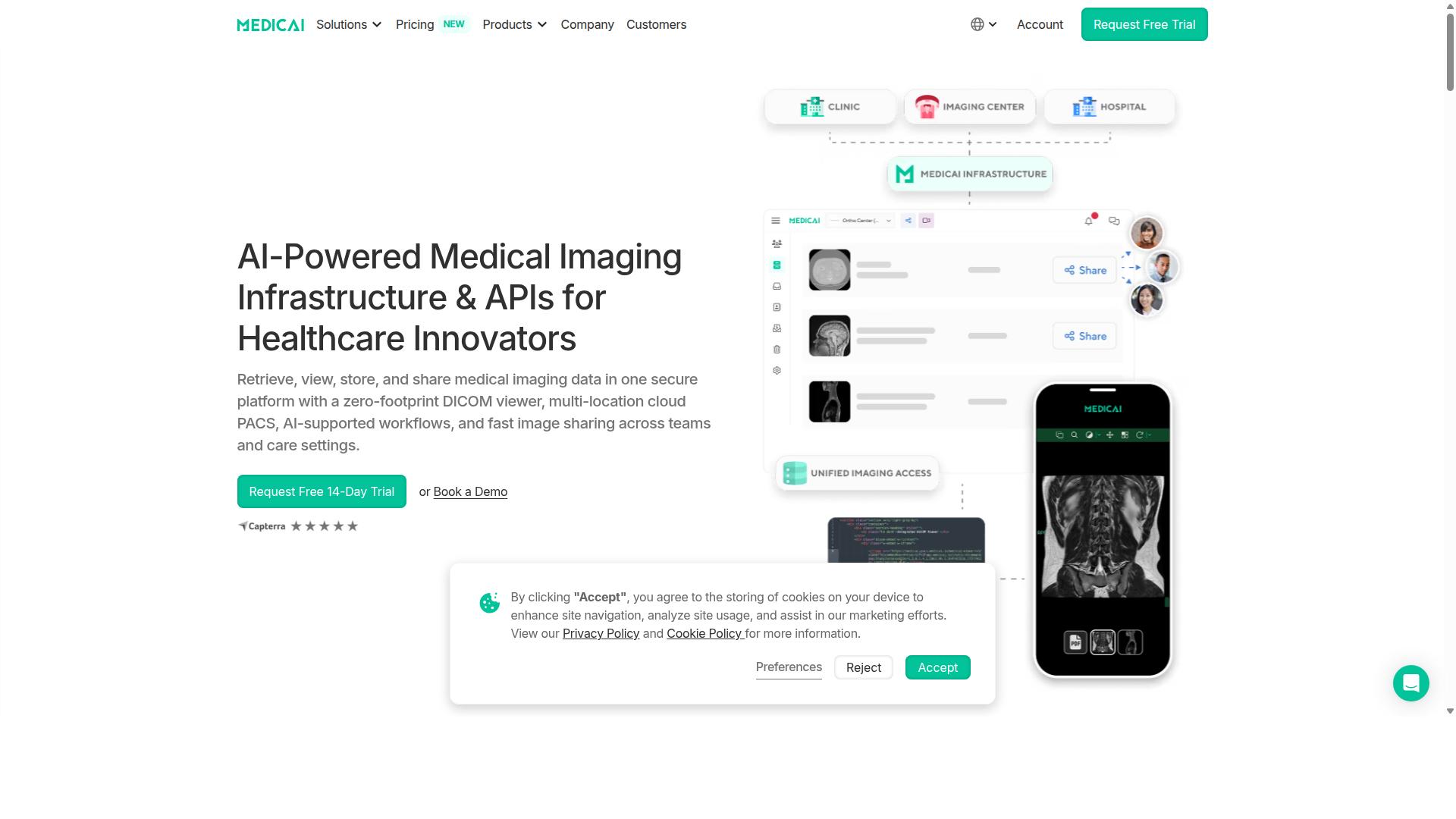
Medicai is a HIPAA- and GDPR-compliant cloud medical-imaging platform that lets providers upload, store, share and view DICOM studies from any browser without installing software.
The platform consists of four core modules that work together as a vendor-neutral archive solution. Each module handles a specific part of the radiology workflow while maintaining interoperability with other systems such as Intelerad, ProtonPACS, and Ambra Health.
CONNECT and RETRIEVE pulls studies from existing modalities, PACS, or external facilities. A typical workflow involves a trauma patient transferred from another hospital where the receiving radiologist retrieves prior studies through the module before the patient arrives.
STORE and MANAGE keeps imaging data in a scalable cloud repository with encryption and audit trails. One common use case is a multi-site clinic network that consolidates studies from several locations into a single, searchable archive instead of maintaining separate on-premise servers.
ACCESS controls who can view or download studies through role-based permissions. For example, an oncologist at a partner hospital can receive secure links to recent scans without needing accounts on the source institution's PACS.
VIEW displays DICOM images in a zero-footprint browser viewer. A referring physician opens the study on a standard laptop during a telehealth visit, annotates key images, and shares findings with the care team in real time.
Research suggests high-volume imaging environments require reliable infrastructure. Medicai has processed over 50 million API transactions each year and delivered more than 300,000 visualizations last year, demonstrating the platform's capacity to support demanding clinical workloads across multiple sites.
The Competitors at a Glance
Three established vendor-neutral archive players, Intelerad, ProtonPACS and Ambra Health, compete with Medicai on cloud storage, interoperability, and radiology workflow integration. Each solution offers different approaches to medical imaging management within healthcare organizations.
Understanding their core positioning helps radiology departments select the right vendor-neutral archive. The following profiles outline how these platforms typically serve imaging centers and health systems.
What Is Intelerad?
Intelerad is a long-standing radiology PACS and workflow platform aimed at large health systems that require enterprise-grade image distribution. Many multi-site radiology departments rely on this system for centralized image access across facilities.
The platform supports enterprise reporting requirements common in hospital networks. Organizations use it for unified medical imaging workflows that span multiple locations and specialties.
Its design focuses on scalability for complex healthcare environments. Health systems choose it when multi-site access and radiology workflow standardization become priorities in their vendor-neutral archive selection.
What Is ProtonPACS?
ProtonPACS offers a hybrid PACS model that combines on-premise hardware with cloud archiving for imaging centers seeking local control plus off-site redundancy. Mid-sized practices often select this approach for their medical imaging needs.
The system balances local server performance with cloud-based data redundancy. Imaging centers appreciate the option to maintain on-premise resources while gaining disaster recovery benefits.
Its positioning targets organizations that prefer traditional infrastructure with modern cloud capabilities. This hybrid model addresses specific requirements around data redundancy and local control in vendor-neutral archive deployments.
What Is Ambra Health?
Ambra Health is a cloud image-exchange platform that focuses on patient and physician portals for sharing studies across organizations. The system emphasizes cross-enterprise document sharing and patient engagement features.
Healthcare providers use it to facilitate image exchange between different facilities and care teams. Patient portals allow individuals to access their medical imaging records directly through web interfaces.
The platform supports image exchange workflows common in collaborative healthcare settings. Organizations select it when patient portal functionality and cross-enterprise document sharing drive their vendor-neutral archive requirements.
What Is Medicai for Vendor-Neutral Archives?
Medicai's Vendor Neutral Archive combines Cloud PACS, Medical Image Exchange, and a zero-footprint DICOM viewer to give healthcare providers a single, globally accessible archive. The platform stores and manages medical imaging data across multiple sites while maintaining full interoperability with existing healthcare systems.
The VNA stack includes four main components. The Vendor Neutral Archive serves as the core storage system. Backup and Disaster Recovery protects data integrity across locations. Patient Case Management organizes studies by patient records, while the DICOM Gateway uploader handles secure image ingestion from various modalities and institutions.
Medicai currently manages over 1.7 million studies and processes more than 50 million API transactions annually. This scale demonstrates proven reliability for healthcare organizations handling large imaging volumes across multiple facilities.
The platform supports radiology workflow through structured reporting, doctor and patient imaging portals, and mobile access capabilities. Integration options include EMR systems via standard protocols like HL7 and FHIR for seamless data exchange.
Features Compared
Three feature sets, storage scalability, security posture, and integration breadth, determine how well each vendor-neutral archive meets multi-site radiology workflows.
Each subsection compares concrete metrics and real-world examples rather than generic statements. The goal is to help imaging leaders choose the right vendor-neutral archive for their specific volume, compliance, and connectivity needs.
Cloud Storage Capacity & Scalability
Storage tiers and automatic scaling directly affect total cost of ownership for growing imaging volumes.
Medicai lists transparent Starter and Standard tiers. The Starter tier provides 500 GB of cloud storage for $249 per month. The Standard tier supplies 2 TB of cloud storage for $749 per month. Both tiers allow unlimited user accounts.
Competitors often rely on hardware-dependent scaling or opaque pricing structures. Organizations may face unpredictable costs when imaging volumes exceed initial projections.
Medicai adds data redundancy and disaster recovery to every tier. Images remain accessible even if a single data center experiences an outage. Each tier supports pay-as-you-grow upgrades without hardware purchases.
Security & Compliance
HIPAA and GDPR compliance plus encryption and audit trails are table stakes for any clinical archive handling PHI.
Medicai holds HIPAA and GDPR certification for its vendor-neutral archive. The zero-footprint viewer carries FDA and CEE clearance. Every object receives encryption at rest and in transit.
Role-based access controls limit data visibility to authorized personnel. Immutable audit logs record every access event and modification. OWASP security guidelines govern ongoing development practices.
Other VNAs also claim compliance. Their specific certifications and audit capabilities vary and often require additional configuration or third-party tools.
API & Integration Capabilities
Modern archives must expose APIs and support IHE profiles to slot into existing EMR and RIS ecosystems.
Medicai processes more than 50 million API transactions each year. The platform supports FHIR and HL7 messaging standards for seamless data exchange. Supported IHE profiles include XDS-I and query-retrieve.
Out-of-the-box connectors enable EMR integration and study routing across multiple locations. These connectors reduce the need for custom development work.
Competing VNAs provide integration options. Their documentation depth and out-of-the-box connectors differ, often requiring extra consulting hours to reach production readiness.
Pricing Compared
Transparent monthly pricing versus opaque quote-based models determines how quickly radiology groups can budget and scale. Medicai publishes clear monthly rates that eliminate negotiation delays and budget uncertainty common with traditional vendors.
Intelerad, ProtonPACS, and Ambra Health rely on custom quote processes that require sales cycles, multiple approvals, and lengthy contract reviews. This approach creates unpredictable costs and delays for radiology practices seeking vendor-neutral archive solutions.
Medicai offers two published tiers with defined storage limits and connectivity options. The Starter plan at $249 per month includes 500 GB cloud storage and unlimited user accounts without connected locations. The Standard plan at $749 per month provides 2 TB cloud storage with one connected location.
Yearly billing reduces these rates by 15 percent to $209 monthly for Starter and $639 monthly for Standard. A one-time DICOM gateway setup fee of $1,000 applies per location. Enterprise customers access custom pricing for additional storage and multiple connected locations.
Consider a practice with 1 TB annual growth. Under Medicai's Standard plan, this storage requirement stays within the included capacity for the first two years without additional fees. Custom-quoted vendors often apply separate storage charges that increase unpredictably over time.
Per-study pricing remains available for enterprise customers requiring flexible usage models. The 14-day Starter trial allows radiology groups to evaluate storage capacity and workflow fit before committing to any vendor-neutral archive solution.
Who Should Choose Medicai
Hospitals, imaging centers, and specialty groups that need scalable cloud storage, global multi-site access, and straightforward pricing gravitate toward Medicai.
Healthcare providers across orthopedics, neurology, oncology, and cardiology often require browser-based access without additional on-premise hardware. Medicai addresses this need through its SaaS model that eliminates physical infrastructure requirements.
Transparent per-month pricing helps specialty practices in ophthalmology, pulmonology, and gastroenterology predict costs accurately. This approach differs from traditional vendor-neutral archive solutions that may involve hidden fees or complex licensing structures.
Virtual care providers and telemedicine platforms benefit from Medicai's cloud storage capabilities. These organizations can share medical imaging across locations without managing local servers or backup systems.
Teleradiology services and tumor boards require reliable multi-site access for DICOM studies. Medicai supports these workflows through its patient portal and integration options with existing EMR systems.
Personal injury lawyers and clinical trial coordinators need secure image exchange capabilities. The platform accommodates these users through its zero-footprint viewer and HIPAA-compliant data handling.
Medical education organizations and ob-gyn practices seeking vendor-neutral archive solutions find Medicai's per-month pricing structure advantageous. This model supports budget planning while avoiding the capital expenses associated with on-premise deployments.
Research suggests that organizations prioritizing cloud-based medical imaging over traditional PACS infrastructure experience improved accessibility across distributed care teams.
Final Verdict
For teams that value transparent pricing, unlimited user accounts, and a zero-footprint viewer backed by proven volume, Medicai stands out among vendor-neutral archive options.
Organizations managing large medical imaging operations need systems that handle substantial throughput without unexpected costs. Medicai processes more than one million studies each year and stores over 1.7 million studies in total. The platform also records more than 50 million API transactions, indicating steady performance at scale.
Many competing vendor-neutral archives use complex licensing models that limit user counts or charge extra for additional logins. Medicai offers Starter and Standard pricing tiers that remove those barriers. Teams can add users as needed without changing the cost structure.
The zero-footprint viewer supports access from different locations and devices, which is practical for multi-site radiology workflows. This approach reduces installation requirements and simplifies maintenance across departments.
Medicai USA is located at 7901 4th St N, STE 300, St. Petersburg, FL, 33702, and can be reached at +1 (832) 220 1035. Medicai Romania operates from 53-55 N Filipescu, 5th Floor, Sector 2, Bucharest, 020961, with a local number of +40 316 305 875. Interested readers can contact sales@medicai.org for details on a personalized demo.