Who's the Best for Zero-Footprint Diagnostic Viewing: ProtonPACS vs Medicai
Radiology teams often face slow image loading and browser compatibility issues when switching between PACS tools for diagnostic viewing.
This article lays out Medicai and ProtonPACS side by side on zero-footprint performance, multi-location access, and AI workflow support so you can decide which platform meets your reading room requirements. By the end you will know which system delivers faster image rendering and clearer compliance features for your specific use case.
Quick Verdict: Medicai Wins for Zero-Footprint Diagnostic Viewing
Medicai's browser-based DICOM viewer eliminates local installations while maintaining full diagnostic quality across modalities. The zero-footprint viewer supports CT, MRI, X-ray, ultrasound, and PET scan images without client software. This approach removes compatibility issues that often affect traditional PACS installations.
Speed and interoperability stand out as the decisive factors. 300k+ DICOM visualizations in the last year demonstrate consistent performance under real clinical loads. The platform also processes 50M+ yearly API transactions, confirming reliable data exchange across different systems.
ProtonPACS and similar solutions typically require some form of local client software or plugin installation. Medicai's architecture avoids this requirement entirely, allowing immediate access from any compliant browser. The result is faster deployment and fewer IT dependencies.
Security remains intact despite the simplified access model. HIPAA and GDPR compliance govern all data handling, while OWASP security guidelines protect against common web vulnerabilities. These standards ensure diagnostic images stay protected during transmission and storage.
At a glance: how Medicai compares to ProtonPACS on the features that matter most.
| Feature | Medicai | ProtonPACS |
|---|---|---|
| Zero-Footprint Diagnostic Viewing | ✓ | — |
What Is Medicai?
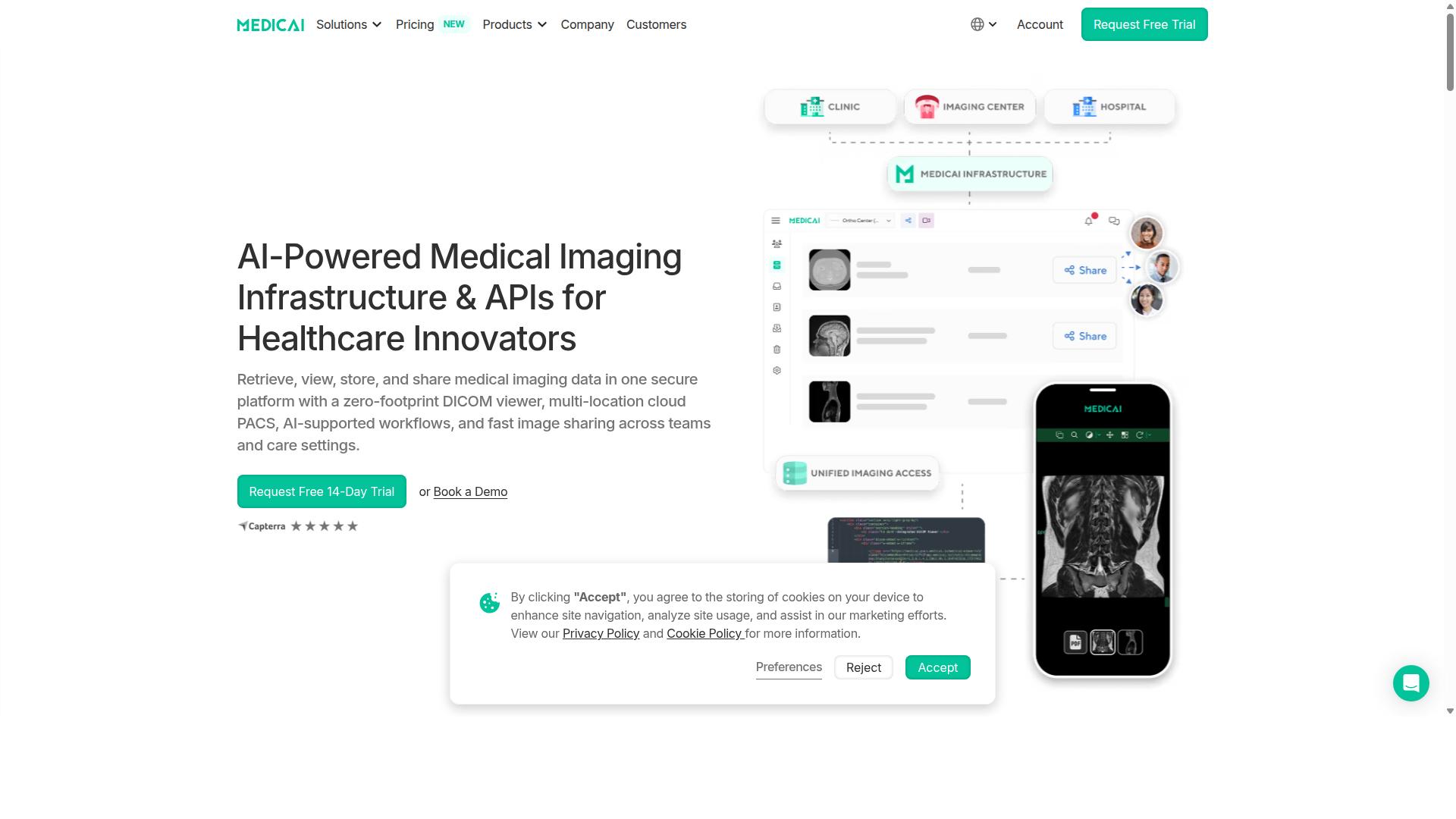
Medicai is a cloud-native medical imaging platform that consolidates retrieval, viewing, storage, and exchange of DICOM studies in one HIPAA- and GDPR-compliant workspace.
The platform delivers five core components that work together. A Medical Imaging Uploader handles secure file ingestion. A DICOM Gateway connects existing hospital systems. A Cloud PACS serves as the central archive. A Vendor Neutral Archive maintains long-term storage independence. Backup and Disaster Recovery protects data integrity.
Medicai currently stores over 1.7 million studies, which demonstrates the platform's capacity for large-scale imaging environments. This scale matters when comparing Medicai to ProtonPACS in a PACS comparison focused on zero-footprint viewer capabilities.
Healthcare organizations evaluating diagnostic imaging solutions need to understand how each platform's architecture supports radiology workflow requirements. Medicai's cloud-native design enables cross-platform access through its built-in DICOM viewer that requires no local installation.
The medical imaging platform emphasizes HIPAA compliance and medical data encryption as foundational elements. These features support secure image sharing across distributed care teams and enable teleradiology operations without additional security layers.
Interoperability remains central to Medicai's approach. The platform facilitates connections between different healthcare systems through standard protocols. This matters when comparing how Medicai versus ProtonPACS handles image distribution across multiple facilities.
What Is ProtonPACS?
ProtonPACS is a traditional on-premise or hosted PACS solution commonly used by radiology groups that require local server control.
Many facilities choose this approach when they need direct oversight of their imaging infrastructure. The system stores and manages diagnostic images through dedicated servers that operate either within the healthcare facility or through contracted hosting arrangements. This setup gives organizations full ownership of their data environment and hardware resources.
Radiology groups often select this model for specific compliance or operational reasons. Local control allows administrators to manage security protocols and system updates according to internal policies. Some practices prefer this arrangement when existing IT teams already maintain similar server-based systems.
However, this architecture requires ongoing maintenance, server updates, and potential hardware investments over time. Staff need technical expertise to manage the system properly and ensure consistent performance across all connected workstations.
Features Compared
The following subsections evaluate three critical dimensions: viewer technology, multi-site access, and security workflows.
ProtonPACS and Medicai take different routes to zero-footprint diagnostic viewing. Each platform offers browser access, yet their approach to cloud infrastructure, user limits, and regulatory controls shapes daily radiology workflow.
Zero-Footprint DICOM Viewer Performance
Medicai's zero-footprint viewer renders full-resolution studies directly in any modern browser, removing the need for dedicated workstations or VPN tunnels.
The viewer runs on standard laptops, tablets, and mobile devices. It supports hanging protocols, real-time annotation, measurement tools, and lossless compression to reduce latency during image distribution.
ProtonPACS also provides browser-based viewing, yet its exact support for hanging protocols and structured measurement tools remains general in public descriptions. Medicai's documented features give radiologists precise control over CT, MRI, and ultrasound studies without local software installs.
Both platforms claim multi-modality support, but Medicai explicitly lists the DICOM Viewer and Mobile Imaging App among its core products. These tools enable cross-platform access without additional client downloads.
Multi-Location Cloud Access & Sharing
Cloud architecture lets authorized users retrieve and share studies across multiple sites without on-site servers or separate exchange portals.
Medicai Starter tier supports unlimited users and no connected locations, while Standard tier adds one connected location for $749/month. The platform transacts over 1M studies yearly, illustrating real-world usage volume across participating sites.
ProtonPACS offers cloud PACS services, yet publicly available details do not specify per-tier location limits or storage caps. Medicai's clear pricing and documented storage tiers allow administrators to match plan size to actual imaging volume.
Enterprise customers needing more locations can upgrade to custom plans that include multiple connected sites. This structure supports teleradiology groups and health systems that share imaging data across regions.
AI-Supported Workflow & Security Compliance
Automated AI routing and built-in compliance controls reduce manual steps while satisfying regulatory requirements for diagnostic imaging data.
Medicai maintains partnerships with MD.ai, Rayscape.ai, and Microsoft Azure that enable AI-assisted diagnostics. The platform holds HIPAA, GDPR, and FDA/CEE clearances. FHIR API and HL7 integration support interoperability with existing hospital systems.
ProtonPACS likely addresses similar compliance needs, yet detailed partnership lists and integration standards appear less transparent in public materials. Medicai's documented vendor-neutral archive and structured reporting tools further streamline image access for referring physicians and tumor boards.
These features position Medicai as the stronger option for organizations seeking explicit AI partnerships, clear compliance documentation, and defined interoperability standards within a single medical imaging platform.
Pricing Compared
Transparent subscription tiers allow radiology departments to forecast costs based on storage and connectivity needs.
Medicai publishes clear monthly rates that scale with data volume and site connectivity. The Starter plan provides 500 GB of cloud storage and unlimited user accounts at $249 per month with no connected locations included.
The Standard plan expands capacity to 2 TB of storage, still unlimited users, and one connected location for $749 per month. Both options operate on monthly billing cycles.
Yearly commitments reduce those rates to $209 and $639 respectively, delivering 15 percent savings for practices that prefer annual contracts.
Enterprise customers receive custom storage allocations and multiple connected locations under tailored pricing models. A one-time $1,000 DICOM gateway setup fee applies per location for on-premise connections.
ProtonPACS pricing structures remain undisclosed on public channels, making direct cost comparisons difficult for procurement teams. Radiology groups evaluating zero-footprint diagnostic viewing platforms often favor vendors that publish rates upfront.
Medicai also offers a 14-day trial of Starter features without requiring a credit card, reducing the risk of testing cloud PACS functionality. Per-study pricing is available for enterprise customers with variable imaging volume.
Who Should Choose Medicai
Hospitals, imaging centers, and specialty groups that need immediate browser access and rapid study sharing across locations benefit most from Medicai.
Specialty care providers find the platform particularly useful when their workflow demands instant access from any location. Orthopedics teams reviewing post-surgical imaging can pull studies without installing software on each workstation.
Neurology and oncology departments gain flexibility when tumor boards convene across multiple sites. Browser-based viewing allows participants to examine CT, MRI, and PET scan images simultaneously without delays from downloads or system compatibility issues.
Cardiology practices benefit when they need to review cardiac imaging alongside reports from referring physicians. Radiology groups handling high volumes of studies appreciate the ability to distribute images to external readers without complex setup procedures.
Virtual care providers and telemedicine platforms integrate the system when their patients span different geographic regions. Teleradiology services use the platform to connect radiologists with facilities that lack on-site specialists, maintaining diagnostic quality through secure image sharing.
Ophthalmology, ob-gyn, pulmonology, dentistry, and gastroenterology practices select Medicai when their workflow includes multiple imaging modalities that require consistent viewing capabilities. Personal injury lawyers and clinical trial coordinators rely on the same browser access to review studies without specialized viewing stations.
Medical education organizations benefit when students and instructors need simultaneous access to case studies from different locations. The patient portal extends similar capabilities to individuals who want to review their own imaging results through a standard web browser.
Who Should Choose ProtonPACS
Organizations that prefer on-premise server control or have long-standing IT infrastructure investments may favor ProtonPACS. These setups often align with facilities that already maintain dedicated hardware teams and established security protocols.
Hospitals with strict data residency requirements sometimes choose this route. Internal policies may require physical access restrictions that only on-site servers can satisfy.
Some radiology groups with existing vendor relationships continue using ProtonPACS because staff members already know the workflow. Training time decreases when teams remain with familiar platforms.
Regional clinics that rarely share images outside their network may find this option adequate. Limited external collaboration needs reduce the demand for browser-based access across multiple locations.
Facilities prioritizing complete system customization often select ProtonPACS. On-premise deployment allows administrators to modify server configurations without external approval processes.
Final Verdict
For teams prioritizing zero-footprint access, enterprise-grade compliance, and predictable cloud pricing, Medicai delivers measurable advantages.
Three key metrics set Medicai apart from competitors across the industry. With 300k+ visualizations processed in the last year, the platform demonstrates consistent performance in real-world diagnostic environments.
Medicai has stored 1.7M+ studies across multiple imaging modalities, building a track record that reflects reliability for radiology practices and hospitals.
The system has handled 50M+ API transactions, showing strong interoperability capabilities that support integration with existing hospital systems and third-party applications.
ProtonPACS remains a viable option for facilities that prefer traditional on-premises solutions or have specific legacy system requirements. However, teams seeking modern cloud infrastructure typically find Medicai provides the flexibility and scalability needed for contemporary diagnostic workflows.
Both platforms offer HIPAA-compliant environments and browser-based viewing capabilities. The difference often comes down to deployment preferences, with Medicai emphasizing cloud-native architecture and ProtonPACS maintaining a more traditional approach.
Medicai USA: 7901 4th St N, STE 300, St. Petersburg, FL, 33702. Phone: +1 (832) 220 1035.
Medicai Romania: 53-55 N Filipescu, 5th Floor, Sector 2, Bucharest, 020961. Phone: +40 316 305 875.
Email: sales@medicai.org